
NRM Success Story
Balford Farms
Burlington, NJ
30-50%
Verified Energy Reduction
52%
Average Fan Runtime Reduction
$0
Out-of-Pocket Project Cost
6.4x
Return on Every Dollar Invested
30-50%
Verified Energy Reduction
52%
Average Fan Runtime Reduction
$0
Out-of-Pocket Project Cost
6.4x
Return on Every Dollar Invested
The Challenge
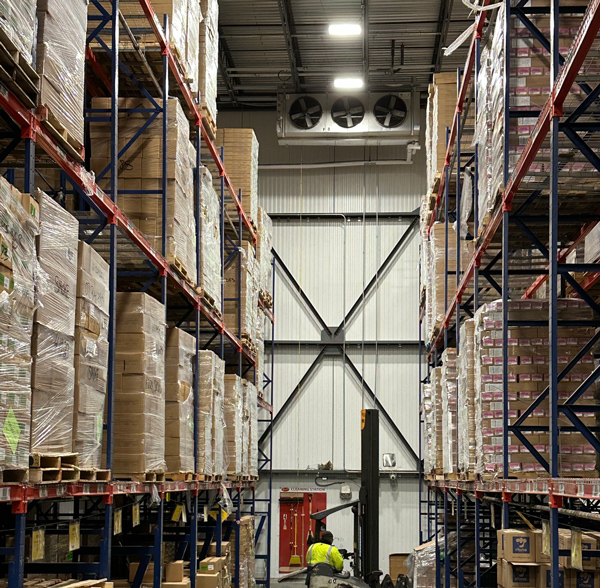
Balford Farms operates 55,000 square feet of refrigerated warehouse to protect a continuous flow of dairy, beverages, and food products — including their popular Rosenberger’s brand — serving foodservice and retail customers throughout the region.
Like most food distribution facilities, Balford’s refrigeration systems were engineered to maintain temperatures for the hottest day of the year. Evaporator fans across all 15 cooling units ran 100% of the time, 24/7, regardless of actual thermal load. Defrosts initiated on a fixed schedule — 6 times per day — whether there was ice build-up requiring it or not.
Their largest cooler used 11 units running in parallel operation for built-in redundancy. This presented huge additional savings beyond the typical 30-40% NRM customers achieve that could be unlocked through intelligent control and management.
Without the management and real-time monitoring tools, compressor performance issues often went undetected — including two aging units that silently failed to respond to nearly 1-in-5 cooling calls over a full year of operation.
What NRM Delivered
- 30-50% Energy Reduction validated by 52 weeks of real-world operational data across all seasons
- Intelligent Fan Management reduced their runtimes from 100% to an average of 47.5% of the time, matched to actual thermal demand
- Demand-Based Defrost reduced the number of cycles from 6 to 2, only needing it when ice actually builds up
- Cloud-Based Monitoring gave them live operational data and performance metrics for all 15 systems
- Hidden Fault Detection identified 2 aging cooler units with persistent compressor response gaps before product was ever at risk
- 37°F Space Temp. Held Year-Round despite the seasonal swings in outside temperatures from 15°F to 90°F
- Warehouse Worker Comfort Improved through the lesser runtimes of the evaporator fan sets; it’s now quieter 50-60% of time
- Future and Growth-Ready as the cloud-based platform can be seamlessly integrated into any new cold-space expansions
"Balford Farms partnered with NRM to implement a cloud-based refrigeration controls platform across our entire facility. The results speak for themselves: dramatic energy savings, real-life visibility into every unit, and we were awarded full funding from our utility provider. This is the kind of investment that pays for itself immediately while also protecting our product around the clock."
— Larry Walker, CEO
How NRM's CoolTrol® Works — One Year of Real Data
The combination of smart controls that optimize operation to run based on cooling need, hardware component upgrades, and preventative maintenance measures lead to proven results.
52% Fan Runtime Reduction
Intelligent Fan Management
Evaporator fans previously ran 100% of the time across all 15 cooling units. NRM’s demand-based, cloud-based monitoring algorithm matches fan operation to actual thermal load. The fansets now average just 47.5% in runtimes across a full 52 weeks of all-season data, with setpoint temperatures held perfectly throughout.
~19% Compressor Gap Detected
Equipment Health Monitoring
NRM’s platform’s continuous monitoring revealed two aging cooler units failed to respond to roughly 1-in-5 cooling calls over a full year. During those failures, fans kept running, which added motor heat rather than cooling the space. Without CoolTrol®, this fault is invisible until the product is put at risk.
37°F Temperature Held All Year
Precision Temperature Control
Despite outside temperatures swinging from 18°F to over 80°F across the 52-week period, CoolTrol® maintained cooler setpoints within fractions of a degree. This protected product quality, supported food safety documentation requirements, and provided real-time temperature logging for QC Teams.
Smart Defrost — Demand-Based Defrost
Prior to NRM’s intervention, electric defrost heaters at Balford Farms initiated on a fixed schedule — 6 times per day — regardless of whether ice had actually accumulated on the evaporator coils. Each unnecessary defrost cycle consumed significant electricity and added heat to the refrigerated space that the compressors then had to remove.
NRM’s demand-based defrost logic monitors actual coil conditions and initiates defrost only when needed. This reduced the number of cycles at Balford Forms from 6 per day to only 2 per day. For the freezer units, this is especially critical because when compressors fail to respond and defrost heaters still cycle, the added heat must be absorbed by the working compressors, which compounds the load on already-stressed equipment.
Smarter defrost also extends compressor and coil life, reduces moisture introduction to the refrigerated space, and improves overall system efficiency across the board.
Compressor Coordination — Lead/Lag Scheduling
Balford’s large cooler section uses 11 refrigeration units in parallel — a design that provides valuable redundancy but also means the systems can work against each other without intelligent coordination.
NRM’s Lead/Lag Sequencing logic assigns priority and staging to each unit, ensuring they cycle together efficiently rather than running independently. This is especially powerful in multi-unit facilities: without coordination, all units may run simultaneously even when one or two could satisfy the load. This is wastes energy and accelerates wear on all compressors equally.
For the aging units at Balford Farms — where compressor response gaps were detected — Lead/Lag Sequencing also ensures the working units carry the load reliably while the system flags the underperforming units for service or replacement.
Tracking 52 Weeks of System Runtime Data
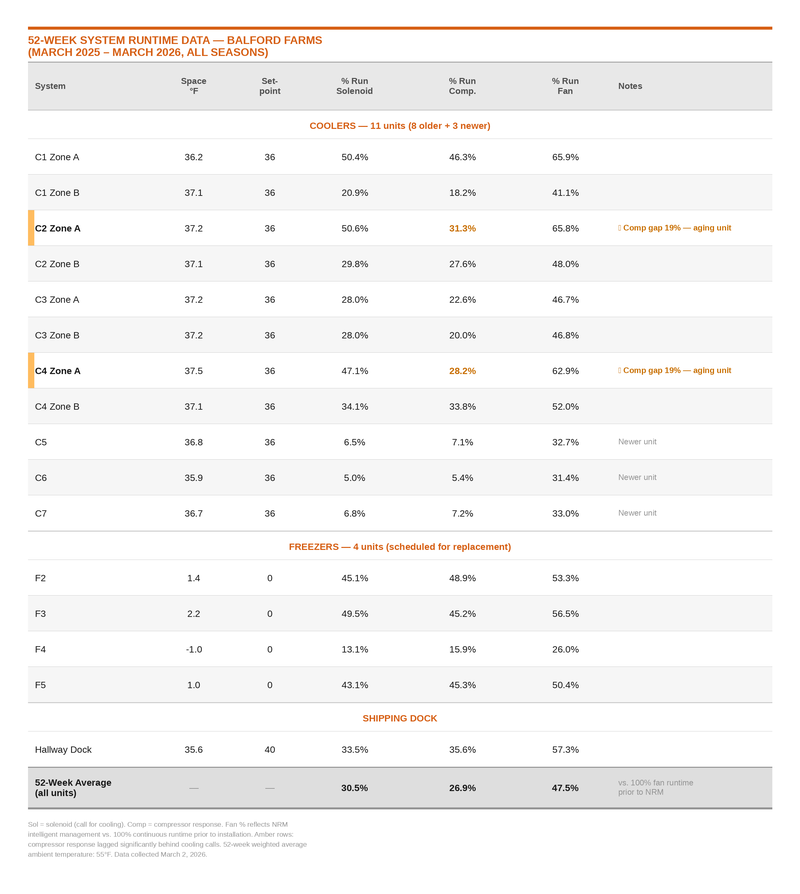
Why the Compressor Gap Matters and why Fan Runtimes are still Understated
When a compressor fails to answer its solenoid’s call for cooling, the evaporator fans keep running, but with no refrigeration effect, they simply recirculate warm air and add motor heat to the space. For freezer units, if the electric defrost heater then cycles while the compressor is down, that added heat must be absorbed by the remaining working compressors, compounding the load system-wide. This means the 47.5% average fan runtime shown above is actually inflated by the fault numbers. Once the four replacement freezer units are installed and integrated with NRM’s controls, system-wide runtimes will improve further. The 30-50% energy savings figure is conservative.
How NRM Works with Your Facility in 3 Simple Steps
01
No-Cost Energy Assessment
NRM’s experienced Energy Advisors survey your refrigeration systems, document your current runtime patterns and energy usage, and calculate your projected savings — both complementary and free of obligation.
02
Utility Incentive Paperwork — We Handle It
NRM manages all incentive applications with your utility provider. Most food facilities in New Jersey qualify for incentives that cover 50-100% of total project cost. PSE&G, JCP&L, and other utilities all participate.
03
Retrofit Installation Leads to Zero Downtime
CoolTrol® is integrated into your existing equipment with no new machinery required. Installation is typically completed with zero disruption to operations. Cloud-based monitoring activates immediately upon commissioning.
For Food Processors & Distributors
If you operate coolers or freezers in New Jersey, you are almost certainly leaving significant energy savings on the table. NRM installs its controls on your existing equipment with no capital outlay, as utility providers often fund the projects. A complimentary, no-obligation energy assessment will show you exactly what you can save.
For Service Contractors & Suppliers
NRM partners with contractors who want to bring added value to their clients. Our control and monitoring platform integrates with new and existing equipment and continuously monitors compressor health, defrost performance, and evaporator fan efficiency. This catches problems before they become emergencies.